
Fuming at dawn, Taal Volcano on the Philippine island of Luzon has three calderas. Fumes rise from smallest caldera on a little lake
on island that is the second caldera. The big lake is the third caldera. On its rim is the city of Tagaytay.
Copyright FilipinaTravels 2023.

Art and gardens greet visitors at the Pinto Art Museum, a treasure-trove of galleries filled with diverse filipino artworks in the city of Antipolo in the Luzon, Philippines,
Sierra Madre mountain range. Copyright FilipinaTravels 2023.

Santorini-styled, this island getaway off the south coast of Marinduque Island features the Bellaroca Resort and Spa, offering luxurious getaway packages.
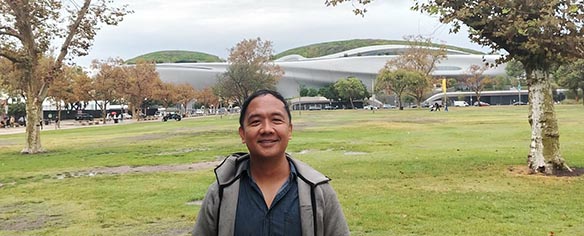
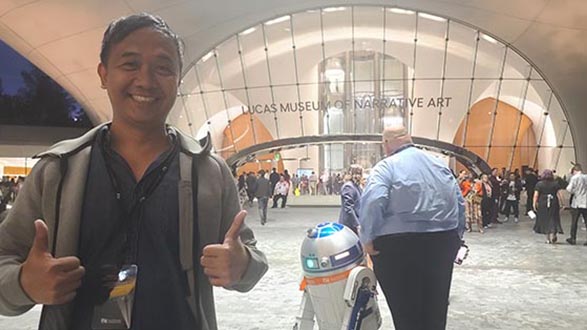
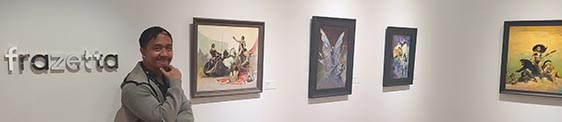
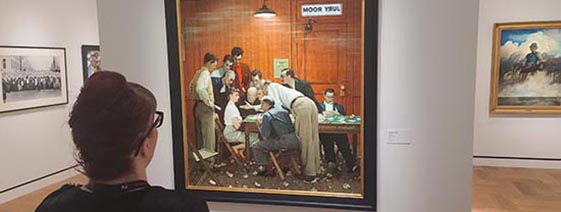
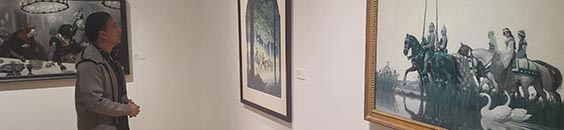
Astonishing New Lucas Museum of Narrative Art
Opens Exhibits in Los Angeles' Exposition Park
|
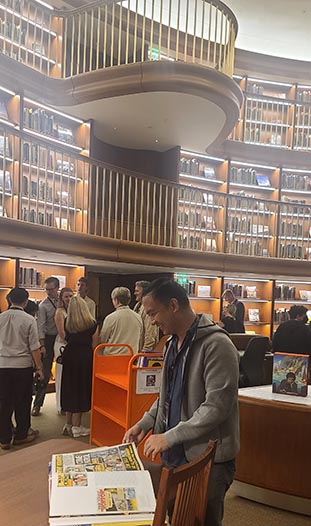
"I'm geeking out here!" exclaimed Joey in the museum's library. |
|
|
|
|
May Way - Philippines |
|
Athena's Traveling Filipinas  Athena follows the following filipinas and filipinos on Insta:
|
|
EXPLORE THE PHILIPPINES WITH US! Here we visit various places in the Philippine Islands in alphabetical order. Antipolo is located in the southern end of the Sierra Madre mountain range on the island of Luzon, Philippines. In addition to an oft visited cathedral, the town features Manila views and the wonderful Pinto Art Museum, a treasure-trove of galleries filled with diverse filipino artworks. 


Baguio is situated amidst
pine-covered mountaintop at the southern end of
the Central Cordillera mountain range. A well maintained highway gets you up there and back down
with spectacular views of steep mountain valleys.
As it is located at high altitude, Baguio is often comfortably cool, often in the mist of clouds, and downpours.
Flowers flourish in the city. Golfers enjoy games on greens amongst pines.
There is a presidential retreat and a former U.S. R&R base, Camp John Hay.
Among the features there is the We Shall Overcome statue,
a likeness of the Statue of Liberty.
Batangas The
resort village of Anilao, pictured below, is at the southern tip of the Mabini Penninsula municipality that forms one side of Batangas Bay.
It and other resorts in the Batangas region are a draw for divers
due to their location along the marine environments of the Verde Island Passage between the West Philippine Sea and the Pacific Ocean.
Among other features, the City of Batangas has the ferry terminal for trips to and from Verde Island in mid passage, as well as to and from Puerta Galera across the passage
on the northern tip of the Island of Mindoro.
 Boracay Island: Widely known for decades as one of the finest swimming destinations in the world, Boracay is blessed with fine talcum powder-sand beaches. Beware that flights land on the island next door, so the final negotiation of a trip from the airport to the airport island's port awaits visitors before they step foot on Boracay. All the island's beaches are open to the public and the hotels bordering the beach are now wall to wall. The island's rapid growth had not been able to be accomodated by the island's sewage system, resulting in it being closed to tourists a few years back. All seems well now.
Chapter 1
BLACK MONDAY, DECEMBER 8, 1941
The word "sukimoko" refers to a good deal, a fair deal. A good deal is what Maria, the store's owner, wants people to get when they shop at Sukimoko, a sari-sari, a small goods retailer in the town of Malabon, located just above the city of Manila on the big northern Philippine island of Luzon. Maria has found that by offering her customers sukimokos she gets more customer traffic in her shop, which results in more sales. Though she doesn't make as much money as she could on each individual sale, the larger sales volume provides her with greater profit. It also helps her sales that Sukimoko is situated on a street featuring a "palengke," a wet market where a great variety of seafood, chicken, and pork is sold, along with vegitables and rice. She sees the young American woman at a rice seller's shop that is across the street from Sukimoko. The American points to rice in a wood rice bin, one of eight square bins that are built side-by-side together at the front of the rice seller's shop, each containing a different grade and type of rice. The woman, who comes by Sukimoko daily, is one of Maria's favorite customers. She reminds Maria of the actress Katherine Hepburn. The rice seller is Maria's sister, Irene. The young American woman points to the type of rice she wants. Inside the shop, Irene leans over a narrow counter and lowers her wooden scooping box, a salop, which is an open-topped cube of a standard size that all rice sellers used. She plunges it deeply into the bin of rice. Irene brings the box back up, filled with rice. She sweeps the back of her hand over the open top of the box to knock the excess rice and levels it off. Then, she dumps the rice into a small burlap bag. In one quick movement, she pulls a short length of twine from a roll, wraps it around the neck of the bag, and jerks the length of twine along a sharp edge of metal beneath the roll, cutting it. Maria's five-year-old son, Emiliano, runs into Sukimoko, screaming gleefully. He is chased by his big brother, eleven-year-old Francisco. The boys move like a whirlwind, quickly circling the store's racks and shelves until Emiliano bumps a metal rack of paper products. It falls over ringing loudly. Attempting a quick escape, both boys rush out the back way, heading into the tight alley behind the shop. There, they hear their mother shout, "Emiliano, Francisco, tigilan ninyo!" words that mean stop (tigilan) both of you (ninyo). Hearing the sharp tone of their mother's voice, both boys come to an immediate halt, and turn, waiting with attention for her next words. "Emiliano, pick up that paper rack and put the products back in their proper places," Maria says in Tagalog. "Francisco, take singko (cinco, five) from the box, buy rice from your Tita Irene (Aunt Irene) for our lunch. Ngayon (Now)!"a "Oh po, Nanay (Yes, Mother)," says Francisco. Words repeated by Emiliano, as the boys move to obey Maria's directions. "Well done," the American woman says, as Francisco darts past her, heading across the street toward his tita's rice shop. "I like a woman who takes command when needed." "Like Eleanor Roosevelt, Ma'am," Maria replies with a smile, recalling the conversation she had the day before with the woman, about the American president and his willful wife. "Like Eleanor Roosevelt," the woman agrees. "And you promised you would start calling me Persephone." "Yes, Ma'am," Maria opens her ledger book to the page where the woman's name is clearly printed, Mrs. Bloom, Persephone. Mrs. Bloom has previously told Maria that she is from the U.S. state of Ohio. She is the bride of an Ohio elevator entrepreneur, whose elevator component warehouse is located just down the street, diagonal from Sukimoko. "I'm bringing elevators to Asia," Maria once heard Mrs. Bloom's dashing elevator entrepreneur husband, who reminds her of Cary Grant, say to a potential client, as they walked past Sukimoko toward the cockfighting ring. Mrs. Bloom browses the products displayed for sale on the wood racks Maria has painted bright primary colors. She ruffles the hair of young Emiliano's head as she passes him restocking the rack he has stood back up. When she glances over at Sukimoko's proprietress, its owner (may-ari), female (babae), female owner (babaeng) Maria, is watching her. "Sentimo (penny) for your thoughts," Mrs. Bloom says with a smile, knowing that Maria understands her, as they have previously spoken many times in English, and as Maria is her most prolific tutor of the Tagalog language, an interesting mix of Spanish and ancient Austronesian, in the Malayo-Polynesian subgroup, Philippine Batanic dialect cluster. Persephone Bloom has a linguistics degree from Yale. A loud roar begins building from somewhere outside, becoming ever deeper, more troubling.
Click below to continue the story. |
|
EXPLORE THE PHILIPPINES WITH US! We continue our visit to various Philippine places in alphabetical order.
Manila:
Manila is the Philippine capitol, with the presidential house, Malacanang, along the Pasig River that bisects the city.
The city's past is seen in the national museum, and a variety of historic monuments, in its century-old churches, and in robust fort Intramuros. While
Manila has exasperating vehicle snarles, an amazing new flyover route four stories above street level, completely avoids traffic jams for those who can afford the toll.
Before the arrival of the Spaniards, the Philippine archipelago was known as Maharlika, which may have come from the Old Malay language meaning "noble creation". The official name of the islands, however, changed throughout the course of Philippine history. The name Philippines and its Spanish counterpart Filipinas are derived from the name of King Philip II of Spain. Despite the presence of other names, the name Filipinas was eventually adopted as the name of the entire archipelago. In the Philippine Revolution , the Philippines was officially called the Republica Filipina, or the First Philippine Republic. From the time of the Spanish-American War until the Commonwealth, American colonial authorities referred to the Philippines as the "Philippine Islands", a translation of the original Spanish. It was in the Commonwealth period that the name Philippines began to appear. It persists as the official name of the nation.
|








.jpg)